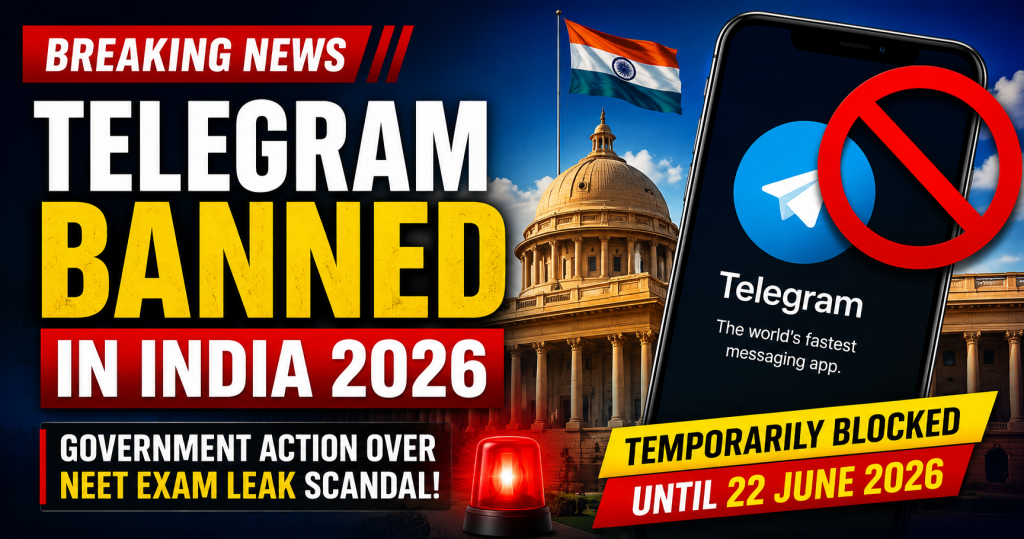
India has once again become the center of national debate after the government temporarily blocked Telegram across the country following allegations that the messaging platform was used to distribute leaked examination materials related to the National Eligibility cum Entrance Test (NEET), one of India’s most important medical entrance examinations.
The decision has sparked widespread discussions among students, parents, educators, technology experts, and digital rights advocates. While authorities argue that the temporary ban is necessary to protect the integrity of the country’s education system, critics believe the move raises concerns about internet freedom and digital communication rights.
Why Was Telegram Blocked?
According to government officials, investigators discovered evidence suggesting that leaked NEET examination papers and answer keys were being circulated through several Telegram channels and groups before the examination took place.
The NEET exam is considered one of the most competitive tests in India. Every year, millions of students compete for limited seats in medical colleges across the country. Any form of cheating or paper leakage can significantly impact the future of countless students.
Authorities launched an extensive investigation after reports emerged that some candidates had obtained access to exam-related materials before the official test date. As the investigation expanded, Telegram became one of the primary platforms under scrutiny.
As a precautionary measure, the government announced a temporary restriction on Telegram services while cybersecurity and law enforcement agencies examined the extent of the alleged misuse.
The NEET Examination Scandal
The controversy surrounding NEET has dominated headlines throughout India.
For many families, NEET represents years of preparation, financial investment, and personal sacrifice. Reports of possible paper leaks triggered outrage among students who spent months preparing honestly for the examination.
Education experts warn that examination fraud undermines trust in the country’s educational institutions. If students believe that exams can be manipulated, confidence in merit-based admissions could suffer significantly.
In response, authorities have promised stricter security measures, including:
- Enhanced digital monitoring
- Stronger cybersecurity systems
- Increased surveillance at examination centers
- Faster investigation of leak allegations
- Tougher penalties for those involved in exam fraud
The government has also reassured students that any verified irregularities will be addressed through legal and administrative action.
Public Reaction Across India
The Telegram restriction quickly became one of the most discussed topics on social media platforms.
Many students supported the government’s decision, arguing that strong action is necessary to prevent future cheating scandals.
Others expressed concern that millions of innocent users who rely on Telegram for education, business communication, and community discussions were affected despite having no connection to the alleged wrongdoing.
Technology experts emphasized that messaging platforms themselves are not necessarily responsible for illegal activities conducted by users. Instead, they argue that authorities should target the specific individuals and groups involved in the fraud.
The debate has highlighted the ongoing challenge faced by governments worldwide: balancing public safety and law enforcement with digital freedom and privacy.
Impact on Students
The controversy has created uncertainty for many aspiring medical students.
Students preparing for upcoming examinations fear that additional security measures or investigation delays could affect admission timelines. Educational institutions have encouraged candidates to rely only on official announcements and avoid misinformation spreading through social media.
Experts advise students to:
- Follow updates from official government sources.
- Avoid sharing unverified exam materials.
- Report suspicious messages or groups.
- Focus on preparation rather than online rumors.
- Verify all examination-related information through official channels.
What Happens Next?
Investigators continue examining digital evidence related to the alleged examination leak. Authorities are expected to determine whether the paper leak originated from organized networks, insiders, or external actors attempting to exploit the examination system.
The outcome of the investigation could lead to major reforms in how large-scale examinations are conducted in India. Education officials are already discussing stronger encryption, improved monitoring systems, and new methods to prevent future leaks.
Meanwhile, millions of students across the country await further updates as the government works to restore confidence in one of India’s most important academic examinations.
Conclusion
The temporary Telegram restriction and the ongoing NEET examination scandal have become defining national issues in India. The controversy highlights the growing challenges of maintaining fairness in large-scale examinations while managing the role of digital communication platforms in modern society.
As investigations continue, the case is expected to influence future policies regarding cybersecurity, education, online privacy, and examination security not only in India but potentially in other countries facing similar challenges.