The technology industry in India is experiencing one of the biggest transformations in modern digital history. Across major cities like Bengaluru, Mumbai, Hyderabad, and New Delhi, conversations about artificial intelligence are no longer limited to software engineers or startup founders. AI-powered software has now become part of everyday life for millions of people.
From students using AI assistants for learning, to creators generating content in seconds, to businesses automating operations with advanced tools, India is rapidly turning into one of the world’s most active and fastest-growing AI software markets.
What makes this movement even more fascinating is that it is happening at an incredible speed.
Only a few years ago, most AI tools were seen as expensive technology designed mainly for Silicon Valley companies and large corporations. Today, many of those same technologies are being adapted specifically for Indian users — including support for Hinglish, local payment systems, regional languages, and mobile-first experiences.
And now, in May 2026, several software platforms are dominating headlines across India and creating massive online discussions among developers, entrepreneurs, creators, and tech enthusiasts.
Many experts believe this is only the beginning.
India’s AI Boom Is Unlike Anything Seen Before
India has quietly become one of the largest digital populations on Earth. With hundreds of millions of internet users and one of the world’s biggest smartphone markets, the country has become the perfect environment for software companies looking to scale rapidly.
But something changed dramatically in 2026.
Artificial intelligence stopped being a “future concept” and became a real everyday tool.
Instead of manually editing videos, people now use AI editors.
Instead of writing emails from scratch, professionals use AI writing assistants.
Instead of spending weeks coding applications, developers are increasingly building software with AI-generated code.
This shift has created an entirely new digital culture.
Across social media platforms in India, phrases like:
- “AI startup”
- “AI automation”
- “vibe coding”
- “AI productivity”
- “AI creator tools”
have become some of the most searched and discussed topics online.
And behind this trend are several software platforms that are now going viral across the country.
The Rise of AI-Native Apps in India
One of the biggest reasons AI software is spreading so quickly in India is accessibility.
Most users are mobile-first.
Unlike many Western markets where desktop computing still dominates productivity, a huge percentage of Indian users rely primarily on smartphones for work, communication, learning, and entertainment.
This has forced software companies to completely rethink how AI products are designed.
The result?
A new generation of AI-native applications optimized for:
- mobile usage
- voice interaction
- regional language support
- low-cost scalability
- instant onboarding
And this strategy is working.
Several AI apps are now experiencing explosive growth across India.
Ixigo’s “Tara” AI Assistant Is Going Viral
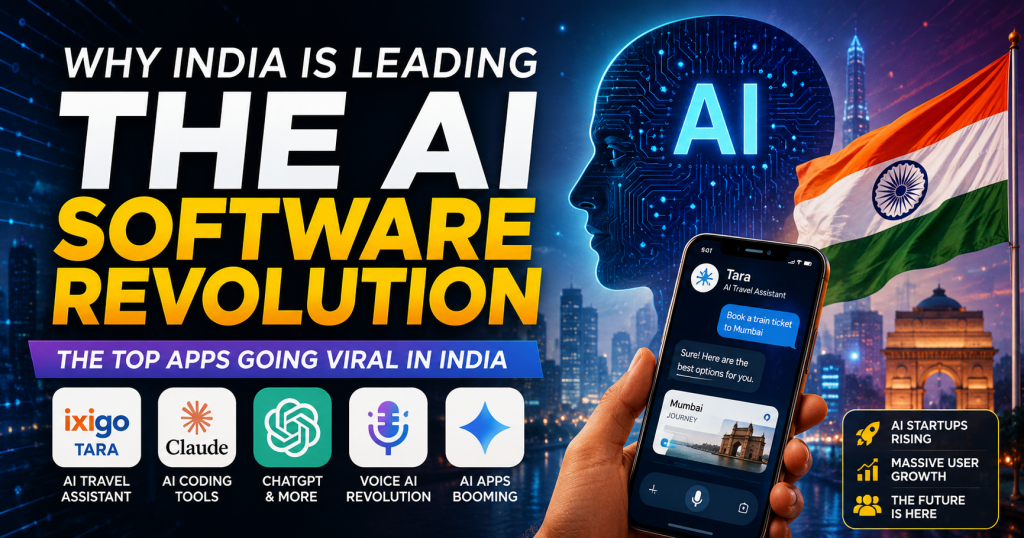
One of the most talked-about software launches in India this week is the release of Tara, the new AI-powered travel assistant developed by Ixigo.
Unlike traditional travel booking apps, Tara functions more like a conversational AI companion.
Users can simply type or speak naturally:
- “Find me the cheapest flight tomorrow”
- “Book a train ticket to Mumbai”
- “Suggest a budget trip for 3 days”
and the AI handles the process automatically.
What truly made Tara stand out is its ability to understand Hinglish — a mixture of Hindi and English commonly used by millions of Indians online.
This instantly made the software feel more natural and local compared to many global AI assistants.
Within hours of launch, clips of people testing Tara flooded social media platforms.
Some users called it:
“The ChatGPT moment for Indian travel apps.”
Others believe this is the beginning of a much larger trend where AI assistants replace traditional mobile app interfaces entirely.
Instead of clicking through menus and forms, users may soon interact with software almost entirely through conversation.
AI Coding Tools Are Changing India’s Developer Industry
Perhaps the most dramatic transformation is happening inside India’s software development community.
For years, India has been known as one of the world’s largest centers for software engineering talent.
But AI coding assistants are now fundamentally changing how developers work.
Tools like:
- Claude AI
- ChatGPT
- GitHub Copilot
- Gemini
- DeepSeek
are becoming essential parts of the programming workflow.
Developers are no longer writing every line manually.
Instead, many are:
- generating code with prompts
- debugging using AI
- automating repetitive tasks
- building prototypes in hours instead of weeks
This trend has created a new internet phrase that is spreading rapidly across India:
“Vibe Coding”
Vibe coding refers to building software primarily through AI interaction rather than traditional coding methods.
In simple terms:
people describe what they want, and AI generates most of the application structure automatically.
This trend has become especially popular among:
- startup founders
- students
- freelancers
- solo creators
- non-technical entrepreneurs
Some Indian startups are now being launched by teams with minimal engineering backgrounds because AI tools are reducing the technical barrier dramatically.
That is one reason many investors are suddenly paying close attention to India’s AI startup ecosystem.
Voice AI Is Becoming Massive in India
Another major reason software companies are focusing heavily on India is voice technology.
Typing remains inconvenient for many users, especially when switching between multiple languages.
As a result, voice AI software is exploding in popularity.
One of the trending examples this month is Wispr Flow, an AI-powered voice productivity tool that supports Hinglish voice input.
Instead of typing messages manually, users simply speak naturally while the AI converts speech into structured text instantly.
For Indian users who regularly mix Hindi and English in conversations, this feels incredibly natural.
The software has gone viral among:
- content creators
- business owners
- students
- remote workers
because it significantly speeds up communication and productivity.
Many analysts believe India could become the world’s largest market for conversational AI within the next few years.
Why Global AI Companies Are Focusing on India
There is a reason why nearly every major AI company is now aggressively expanding into India.
The market conditions are almost perfect.
India offers:
- enormous internet adoption
- young tech-savvy users
- rapidly growing startups
- affordable mobile data
- one of the world’s largest developer communities
This creates a powerful environment for AI software growth.
Several global firms are now prioritizing India for:
- beta testing
- product launches
- localization
- AI partnerships
- user acquisition
And the competition is becoming intense.
Both international and local companies are racing to dominate India’s AI market before it becomes fully saturated.
India’s Startup Ecosystem Is Entering a New Era
The AI software wave is also reshaping startup culture in India.
In previous years, launching a tech startup required:
- engineering teams
- large funding
- long development cycles
Today, AI tools are dramatically lowering those barriers.
Small teams can now:
- build apps faster
- automate customer support
- generate marketing content
- analyze data instantly
- create designs with AI
This means more startups can launch with less money.
As a result, India is seeing a huge increase in:
- AI SaaS startups
- automation companies
- AI creator tools
- AI education platforms
- AI fintech solutions
Some investors believe India could become one of the largest AI startup ecosystems globally within this decade.
The Hidden Concern Behind the AI Boom
However, not everyone is fully optimistic.
Many professionals are beginning to worry about the long-term impact of AI software on employment.
As AI tools become more advanced, tasks that once required large teams can now be handled by small groups using automation.
This has created growing concerns in industries such as:
- customer support
- content writing
- basic programming
- graphic design
- administration
Some companies are already restructuring workflows around AI productivity systems.
At the same time, others argue that AI will create entirely new categories of jobs and opportunities.
The debate is becoming increasingly intense.
And India is now at the center of that conversation.
The Future of Software Is Being Rewritten
What is happening in India today may represent the future of software globally.
Applications are evolving from static tools into intelligent digital assistants.
The old model of clicking menus and navigating complex interfaces may eventually disappear.
Instead, users are beginning to expect software that can:
- understand natural language
- automate workflows
- personalize experiences
- predict needs automatically
In many ways, India is becoming a testing ground for this future.
The country’s massive digital population, combined with rapid AI adoption, is accelerating innovation faster than many expected.
And judging by current trends, the next few years could completely redefine how people interact with technology.
Final Thoughts
India’s AI software explosion in 2026 is not just another technology trend.
It represents a massive shift in how people work, communicate, build businesses, and interact with digital systems.
From AI travel assistants and voice-powered apps to automated coding tools and creator platforms, software is becoming smarter, faster, and more human-like than ever before.
For millions of users across India, AI is no longer something experimental.
It is becoming part of everyday life.
And if current growth continues, India may soon emerge as one of the most important AI software markets in the entire world.