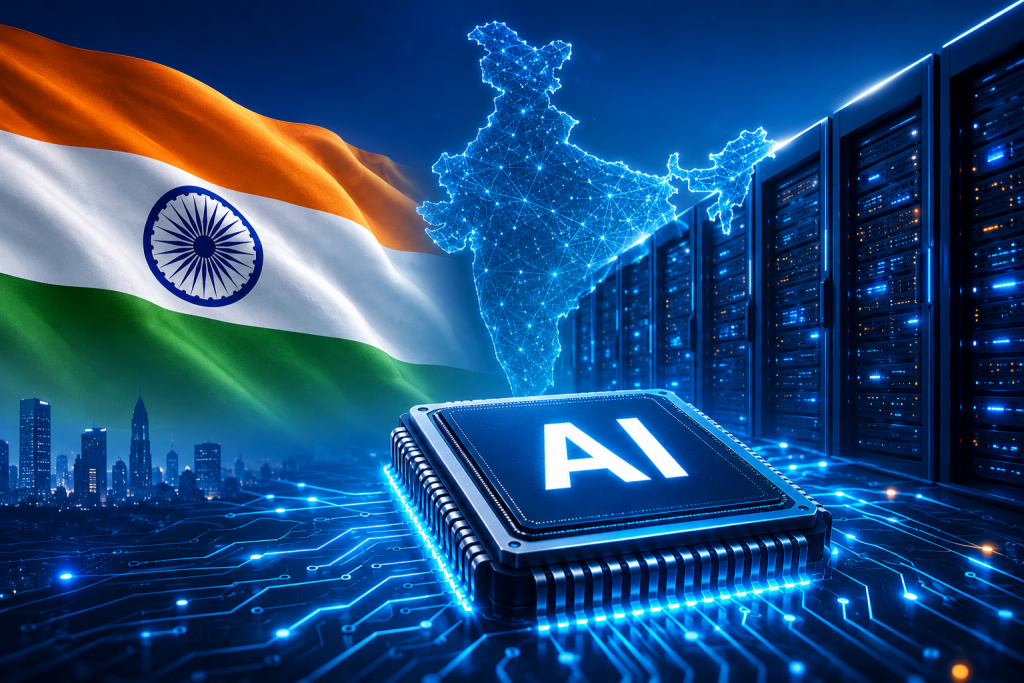
India is making one of its boldest technology investments ever through the IndiaAI Mission, a national initiative designed to build the country’s AI infrastructure and reduce dependence on foreign technology providers. With more than 38,000 GPUs already deployed and plans to add over 20,000 additional GPUs, India is rapidly emerging as a serious contender in the global AI race.
The initiative is backed by an investment of more than ₹10,300 crore, making it one of the largest government-led AI programs in the world. The goal is simple: provide affordable AI compute resources to startups, researchers, universities, and enterprises so they can build world-class AI models without relying entirely on foreign cloud providers.
Why GPUs Matter
Modern artificial intelligence runs on powerful graphics processing units (GPUs). These chips are essential for training large language models (LLMs), developing generative AI applications, and powering advanced machine learning systems.
Historically, access to high-end AI computing has been dominated by a handful of global technology companies. India is now changing that equation by creating a national AI compute network that democratizes access to advanced hardware for local innovators.
Building a Sovereign AI Ecosystem
India’s vision extends beyond simply acquiring hardware. The country is working toward creating a complete AI ecosystem that includes:
- National AI compute infrastructure
- Indigenous AI foundation models
- Multilingual AI systems for Indian languages
- AI research and development programs
- Startup support and affordable cloud access
The government has emphasized the importance of developing “sovereign AI”—AI systems built, trained, and operated within India for Indian users and businesses.
The Rise of Indian AI Models
The new infrastructure is already helping Indian AI companies develop domestic alternatives to global AI models.
Companies such as Sarvam AI have received access to government-supported computing resources to build advanced AI models optimized for Indian languages and use cases. During the India AI Impact Summit 2026, several new Indian AI models were unveiled, demonstrating the country’s growing capabilities in generative AI.
Affordable AI for Startups
One of the most significant aspects of the IndiaAI Mission is cost reduction.
The program offers AI compute access at heavily subsidized rates, enabling startups and researchers to train models at a fraction of the cost typically charged by major global cloud providers. This lowers barriers to entry and creates opportunities for a new generation of Indian AI entrepreneurs.
Competing on the Global Stage
The global AI race is increasingly becoming a competition for computing power. Countries that control large-scale AI infrastructure gain advantages in research, innovation, economic growth, and national security.
By expanding beyond 58,000 GPUs in the coming phase, India is positioning itself as one of the largest publicly supported AI compute ecosystems in the world. The initiative signals that India intends to compete not only as a consumer of AI technology but also as a creator of next-generation AI systems.
Conclusion
India’s AI strategy is no longer just about software talent. It is now about building the infrastructure needed to power the future of artificial intelligence.
With tens of thousands of GPUs, billions of rupees in investment, and a growing ecosystem of AI startups, India is laying the foundation for a sovereign AI future—one that could transform the country’s technology landscape and strengthen its position in the global AI economy.
The message is clear: India is not waiting for the AI future. It is building it.